

Precast or in-situ
compared
A skatepark often stays in place for 25 years or more. Much changes over that time: the land-use plan, demand, the riders. Here we show what building with precast elements means over that time for the site, the material and the budget. And where in-situ concrete has the edge.
At the start and at the end
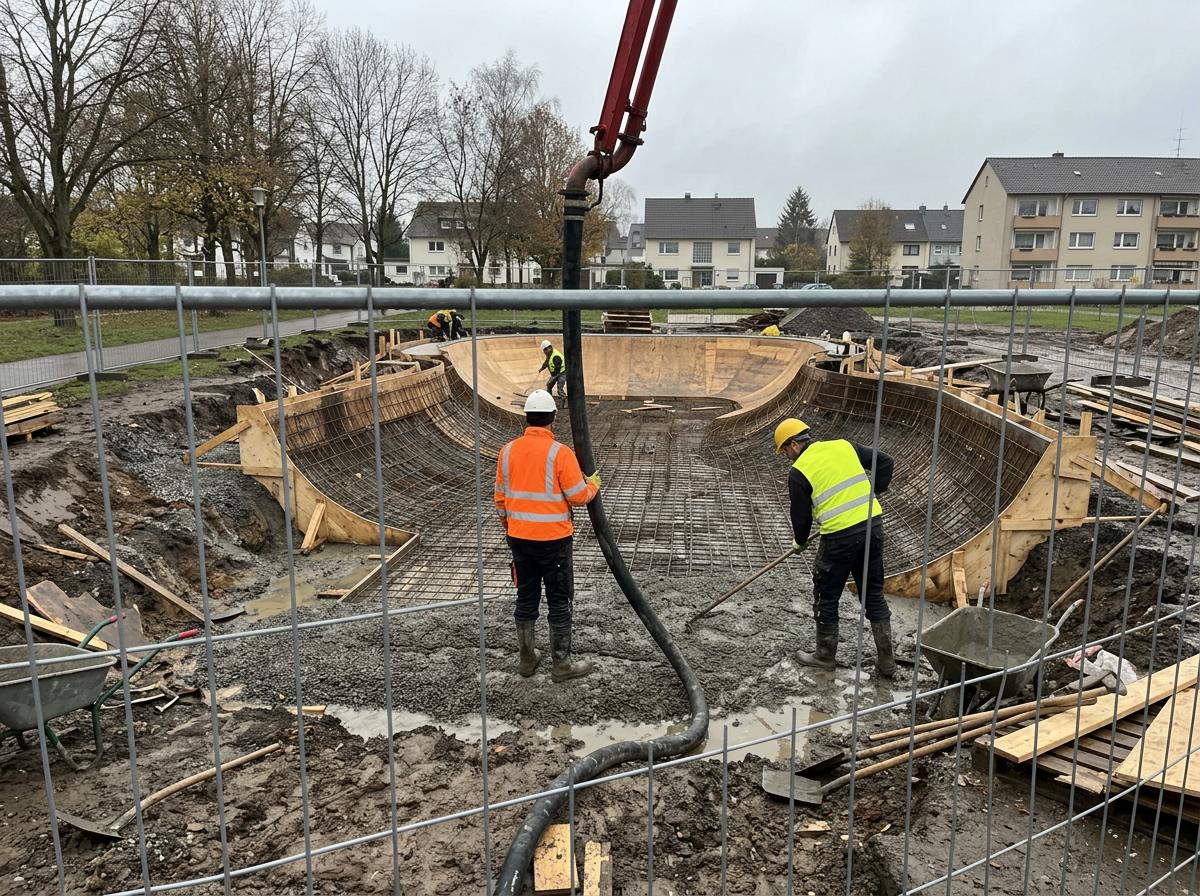

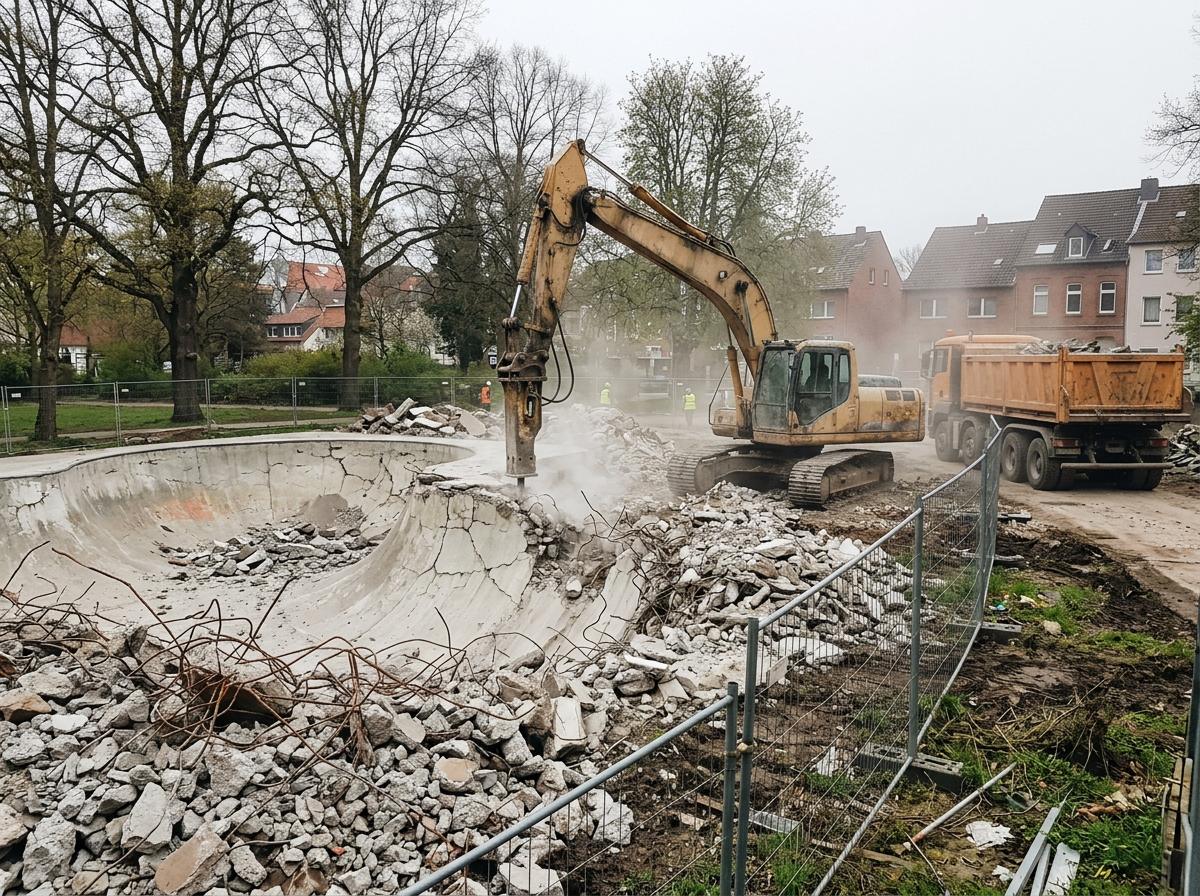

Modular and in-situ point by point
| Criterion | A+ precast elements | In-situ concrete |
|---|---|---|
| Base | Existing asphalt or concrete surface with transition plates, a new foundation slab or a compacted gravel bed | Excavation, sub-base and concrete body across the whole park |
| Newly paved area | None, if a paved surface already exists | The entire footprint of the park |
| Time on site | A few days, hardly affected by weather | Several weeks, depending on weather and curing |
| Quality control | At the factory, in steel formwork, monitored by TÜV (EN 14974) | On site, depending on the crew and the weather |
| Durability | First elements in use for more than 25 years without refurbishment; edge profiles cast in | Long, if well built; damage is repaired on site |
| Changing it later | Rearrange, add or replace individual modules | Only by demolishing and rebuilding the affected part |
| Moving the park | Possible, with a crane or forklift | Not possible |
| End of use | Elements are reused elsewhere; otherwise concrete and steel are separated and processed as recycled building material | Demolition; the broken concrete is usually processed as recycled material |
| Free form | From a kit of tested modules that can be combined almost freely | Advantage of in-situ concrete: any shape possible, seamless transitions |
| Cost | Predictable per module; no earthworks on existing surfaces | Depend heavily on the site and the shape; often economical for large, simple areas |
A general comparison of the two methods. What applies to your site is clarified during design.
When modular pays off
A site with an open future
A car park, schoolyard or building plot is used for a few years until something else is built there.
Building in stages
The municipality starts with a few elements and adds more when new funds are available.
Old ball court
An asphalt area that hardly anyone uses any more becomes a skatepark.
Summer on the beach
A pipe stands on the promenade for the season and goes into storage in autumn.
Concrete is still concrete
Making cement emits CO₂, for our elements too. The construction method does not change that. What it changes is how often something has to be built, demolished and built again.
There is no life-cycle assessment (EPD) for our elements yet. That is why we do not state CO₂ figures or carry an environmental label.

Modules in storage: what leaves one park is used again in the next.
Still unsure?
And on a greenfield site?
There, modular construction also needs a paved riding surface. The difference then lies mainly in alteration and removal. Individual pipes only need a compacted gravel bed.
Can elements that were concreted in also be moved?
Yes, but removal takes more work than for elements that simply stand on the surface. If you expect to move the park later, choose installation with transition plates.
Your site, our design
Send us a site plan or a photo. We will tell you which installation option fits.
Enquire about a project